
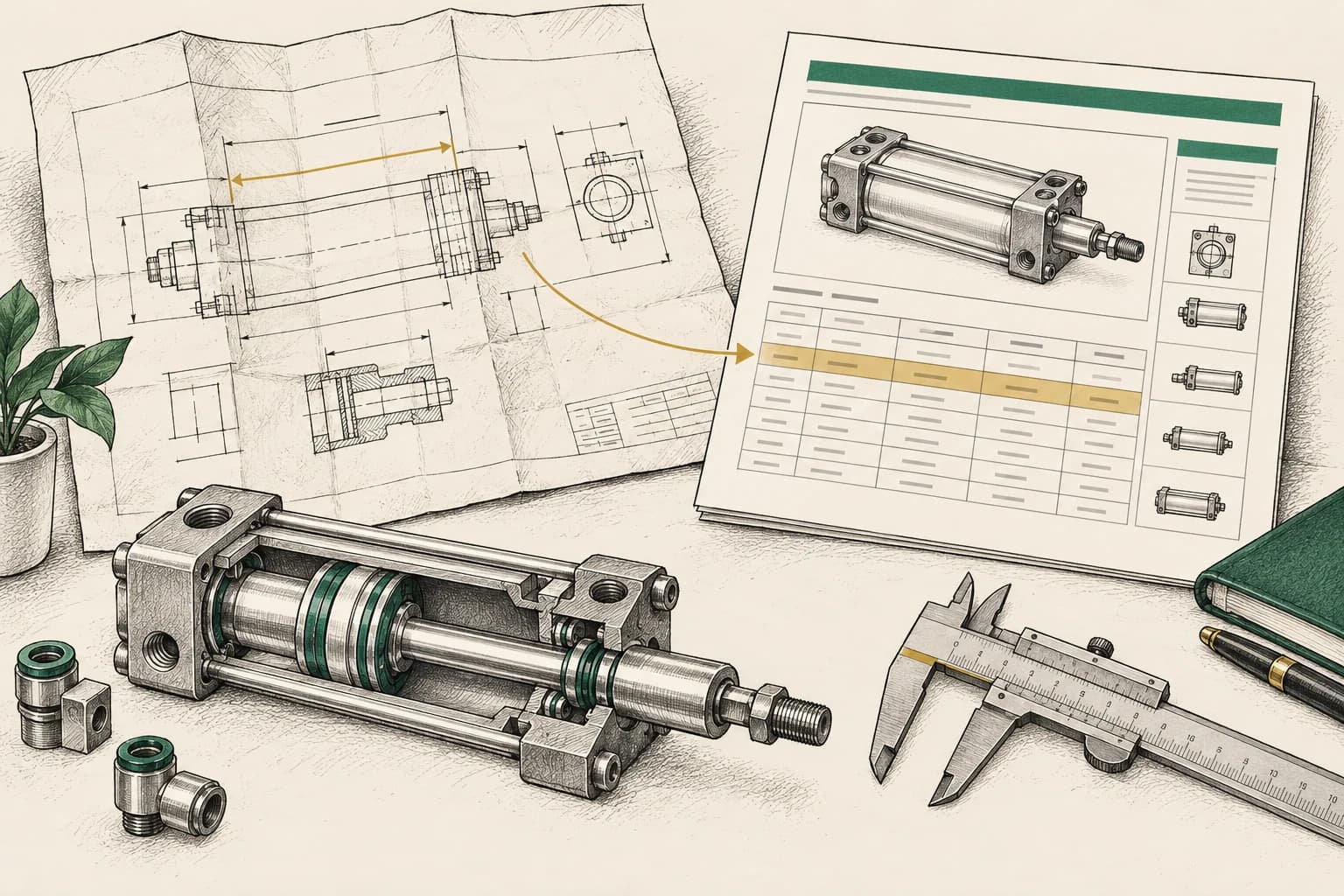
Turn equipment specifications into product-page answers by preserving the source facts and explaining how a buyer uses them to assess fit. Keep model identifiers, units, revisions and operating conditions intact. Put the relevant variants in a readable table, explain the selection fields and link the supporting drawing or document.
Show what the buyer can establish now and what needs technical confirmation. Keep limitations beside the specification they qualify, and distinguish availability or indicative price from suitability. A quote request should carry the selected model and application context to sales.
Have a product specialist approve the interpretation. Publish one checked example before expanding, and assess enquiry quality before claiming that a clearer page increased sales.
Treat the source document as the authority for values
Retain the document name, revision date, model identifiers, units and stated operating conditions. If you also use distributor information, distinguish it from the manufacturer record.
A value can belong to a family, a variant or a particular test condition. Check which one before putting it in a headline. Do not make a maximum operating limit sound like a recommendation for every application.
When two documents disagree, ask the relevant technical owner. A copywriter should not resolve the conflict by choosing the value that sells better.
Organize the page around the selection task
A known-model buyer needs to confirm the correct variant and supporting details. An application-led buyer needs to understand which information determines selection.
Make the product family clear, then show the model or variant table. Explain the selection fields in ordinary language while keeping their technical meaning. Link the original document for someone who needs the full drawing or data.
The page should say when the buyer needs help. “Send the current model and application details so we can confirm suitability” is more useful than a general promise that the product suits every requirement.
The product expert checks the facts. Editorial clarity does not authorize a new compatibility or performance claim.
A source-to-page transformation
Here is a constructed editorial example. It shows how to organize information, not specifications for a particular machine. No values or performance claims have been invented.
| Source information | Page treatment | Review question |
|---|---|---|
| Several model codes | A readable variant table with the code retained | Does each row refer to the correct product? |
| Dimensions and a drawing | Labeled dimensions linked to the drawing | Are units, orientation and revision consistent? |
| Operating range | Range shown beside the conditions and exclusions | Could a reader mistake a limit for an intended operating point? |
| Options | Explain standard versus optional configuration | Is each option available for this model? |
| Application notes | Selection considerations and boundaries | Has a qualified reviewer approved the interpretation? |
| Service details | State delivery, installation or support scope separately | Is this a supplier commitment or a manufacturer specification? |
The writing task is to explain the relationships. The technical task is to approve them. Keep both owners involved.
What an existing component example demonstrates
The SN Machinery case describes model tables, application information and quote routes on an industrial component site. It also describes a cylinder-force calculator and related selection content.
Those features illustrate ways to help a buyer investigate fit. Their existence does not mean every calculation or new application statement in your own page has been verified.
For complete machinery, additional information may be necessary: utilities, installation, commissioning, maintenance, training and service geography. Gather the relevant supplier records before claiming those terms. A component example cannot establish complete-line performance.
Explain limitations near the claim
A buyer should not discover a critical operating condition only after scrolling through a promotional page. Keep it close to the specification it qualifies.
Explain what depends on the material, configuration or operating environment where the source supports that dependence. If you do not know the answer, identify the information needed to confirm it.
Avoid turning uncertainty into a broad assurance. “Our team needs to confirm this configuration” is a usable next step. “Suitable for all applications” is a claim that needs unusually strong evidence.
A clearer explanation must preserve the conditions. It cannot introduce a new performance or compatibility promise.
Keep price and availability separate from technical suitability
A displayed price may be indicative, specific to a configuration or subject to quotation. State which. Date time-sensitive information and make responsibilities clear for updates.
Availability does not establish compatibility. A matching product-family name does not establish an interchangeable replacement. Help the buyer provide the model and context needed for confirmation.
If a quote request starts from a variant row, retain that context in the request. Make it possible to add uncertainty or an application note without forcing the buyer to select an unconfirmed option.
Review the proposed page as a buyer and as a specialist
The buyer review asks whether someone can find the right row, understand the next decision and contact the right person. The specialist review checks whether the page preserves the source facts and their limits.
Test the layout on a phone. A wide table should remain navigable with its column headings available. Do not hide the crucial condition in text that appears only on hover.
Use meaningful labels for drawings and links. “Download document” is less useful than a document name that includes the product and revision where known.
Publish one checked example before creating a library
Retain the source sheet, the approved copy and the actual page version. If you are presenting a before-and-after, keep both versions so the comparison can be inspected. A proposed rewrite should be labeled as proposed.
Then ask sales whether the revised information helps them clarify requests. Examine actual enquiry categories before claiming a conversion improvement. A cleaner page can be useful even when there is not yet evidence of a sales lift.
TCC can help turn technical evidence into buyer-facing content. Your product expert supplies and reviews the facts; we organize the explanation and the path to enquire.
Frequently asked questions
What should an equipment product page include?
Include the reviewed model information, intended applications, operating limits, compatibility conditions and the details needed to enquire. State which requirements need confirmation.
What if a specification is missing?
Obtain it from the approved source documents or technical reviewer. Keep the requirement open for confirmation rather than adding a plausible value.
How should the page lead into a quote?
Let buyers share a known model or describe their application. Pass that context to the team who can verify fit, availability and the next commercial step.
Sources
This is a proposed editorial workflow for translating technical documents into buyer-facing pages. It is not a measured conversion study or a substitute for manufacturer specifications. No product datasheet was supplied for a worked model example. Evidence scope and technical-review requirements